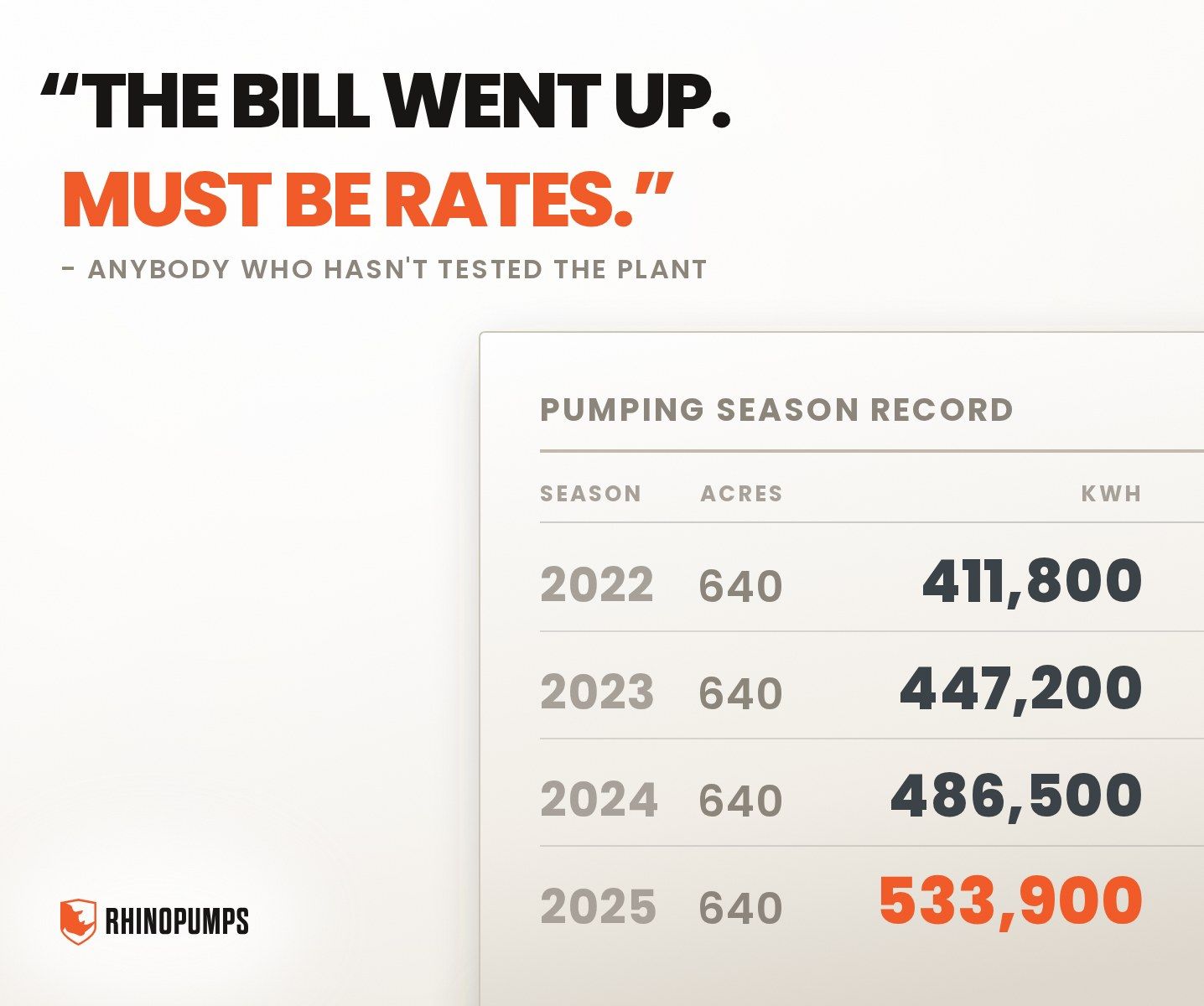
Every irrigation pump gets sized for one number. That worked when the number held still, and it does not hold still anymore.
Somebody hands you the acreage and the delivery, you find a pump that hits it efficiently, and you buy it. For decades that was the whole job, and it was a reasonable way to do it.
Then allocations moved. Wells got restricted. Crop plans changed on a three year cycle instead of a twenty year one. Your delivery became a range whether you specified for one or not, and the pump you bought is still sized for a single point on it.
This is about what that costs you, and what to buy instead.
Your delivery is a range, whether you specified for one or not
Start by writing down what your pump actually sees over a season rather than what the selection sheet says.
Water availability moves. Surface allocations get cut in a dry year and restored in a wet one. Groundwater districts add restrictions that change how much you can pull and when. Neither of those events asks whether your pump was sized for it.
Crop plans move. A quarter that was in alfalfa is in corn two years later, and the water demand curve across the season is a different shape. Acreage under a pivot changes as fields get split, added or retired.
And the well itself moves. If the static water level has dropped since installation, the pump is lifting further than the selection assumed, which means it is sitting somewhere on its curve that nobody chose.
So the honest description of your duty is not a number. It is a low end, a high end, and a number of hours at each. Most operations have never written that down, which is why most irrigation pumps are excellent at one flow and mediocre everywhere else.
A pump is efficient across a band, not across the curve
This is the part that makes sizing to a point expensive.
A centrifugal pump has a best efficiency point, and efficiency falls away on both sides of it. Pick a pump for a single number and it is excellent at that number, acceptable near it, and poor at the edges of the range you actually operate in.
That costs you in more than one place. As our pump sizing guide puts it, operating a pump far from its best efficiency point increases vibration, heat and wear. So every hour spent away from the design point shows up as a penalty on the power bill and as shortened bearing and seal life, on a machine that was never selected to run there.
The point was never the thing you operate at. It was the thing you happened to know on the day you bought the pump.
The practical test is simple and you can do it this week. Pull the curve on your main irrigation pump. Mark where it sits at today's delivery. Then mark where it would sit if delivery dropped by a third. If that second mark falls off the efficient part of the curve, you have a decision coming, and you would rather make it before the pump makes it for you.
Three ways to cover a range, and what each one costs
Once you accept that the duty is a range, there are three honest ways to serve it. They are not equally good.
One. Variable speed
A drive lets one pump cover a band instead of forcing you to pick which year to be right about. The argument against a drive has always been first cost measured against a fixed duty, and when the duty moves, that comparison was never the right one.
The reason a drive pays is in the affinity laws, which let you scale pump performance to a different speed without running a new test. Flow moves roughly with speed. Head moves roughly with the square of speed. Power moves roughly with the cube of speed. Which means a modest speed reduction is not a modest power reduction.
Now the caveat, because this is where the math gets oversold. That cube relationship assumes a system curve that runs through the origin, meaning all friction and no static head. An irrigation system has real static lift and a real pressure requirement at the nozzle, so the curve does not start at zero and the actual savings land below what the textbook cube law suggests.
That does not make a drive a bad decision. It makes the sales math worth checking. Ask for the calculation on your system curve, with your static lift and your operating pressure in it, rather than the generic version. If the number holds up on your curve, it holds up.
A drive is also a controls decision, not only a pump decision. Enclosure rating, heat, harmonics and how the drive is programmed all determine whether it survives the environment it is installed in. Ours are built in a UL 508A listed panel shop, which is worth asking any supplier about.
Two. Staging
Two smaller pumps that run alone or together cover a wide range at decent efficiency across all of it. One large pump throttled down covers the same range badly.
Staging has a second benefit people undervalue. Two units mean you still have water when one is down, and it means service can happen inside a season rather than between them. For an operation where a week without water is a yield event, that is worth more than the efficiency argument.
Three. Throttling, which is the expensive one
Closing a valve to reduce flow works, in the sense that less water comes out. What is happening physically is that the pump is still producing head and you are destroying it across the valve.
You are paying for pressure and then throwing it away. Our sizing guide is blunt about this: operators throttle the discharge to compensate, which wastes energy and adds unnecessary wear. It is the default because it costs nothing today, and it is the most expensive way to run a variable duty over ten years.
What to put in the spec, and one thing to check first
The spec question changes once you are sizing for a range. Stop asking what flow you need. Start asking:
- What is the low end of the delivery, and how many hours a season do you expect at it
- What is the high end, and how many hours there
- What is the static lift now, measured, not from the original well report
- What pressure does the system actually need at the far end, not at the pump
- What happens to the rate schedule at a lower annual run time, because demand charges do not scale down the way energy charges do
That is a different pump than the one you get by naming a single flow, and it is frequently a cheaper one to run.
One thing to check before you price any of it. If the plan is to cover a surface shortfall with a well, check the basin before you price equipment. Several western states have stopped issuing new rights in stressed basins, so a well is a water rights question before it is a pump question. We do not drill wells and we do not do well or shaft construction, so this is not us selling you one. It is the step that determines whether the rest of the conversation is real.
Pick equipment that does not care what the number is this year. The number is going to change again.
What to do this week
- Pull the curve on your main irrigation pump and mark where it sits at today's delivery.
- Mark where it would sit if delivery dropped by a third. If that falls off the efficient band, you have a decision coming.
- Count the hours you actually run at each end of the range, not just at the design point.
- Measure current static water level and compare it to the original well test.
- Ask your power provider what your rate schedule does at a lower annual run time.
- If a well is in the plan, check basin status and available rights before pricing equipment.
Service Territory
Sales, service and engineered pump packages across the Intermountain West and Southwest. Pump repair is also accepted from Oregon, New Mexico, Wyoming and Montana.
Utah
Headquarters and main shop in Pleasant Grove, serving irrigation, municipal and industrial accounts statewide.
Idaho
Caldwell branch covering the Treasure Valley and the Magic Valley irrigation districts.
Arizona
Phoenix branch covering central and southern Arizona ag and municipal work.
Nevada
Northern and southern Nevada coverage for irrigation, mining and municipal service.
Washington
Kirkland branch covering western Washington and the Columbia Basin.
Colorado
Longmont branch covering Front Range and eastern plains irrigation and municipal accounts.
Frequently asked questions
How do I size an irrigation pump when my water allocation changes every year?
Size for the range instead of the point. Write down the low end of your delivery, the high end, and roughly how many hours a season you expect at each, then select for efficiency across that band rather than at a single flow. A pump chosen for one number is excellent at that number and poor at the edges of the range you actually run in, and you pay the difference on every hour spent away from the design point.
Is a variable frequency drive worth it on an irrigation pump?
It depends on how much the duty actually moves and on how much of your total head is static. Power moves roughly with the cube of speed, so a modest speed reduction is a large power reduction, which is the case for a drive. But that cube relationship assumes a system with no static head, and an irrigation system has real lift and a real pressure requirement, so the savings land below the textbook figure. Ask any supplier to run the number on your system curve with your static lift in it rather than the generic version. A drive is also a controls decision, so enclosure rating, heat and programming matter as much as the drive itself.
Is it better to run two smaller pumps or one large pump?
For a duty that moves, two smaller pumps that can run alone or together usually beat one large pump, because they cover a wide range at decent efficiency across all of it instead of covering it badly from a single point. Two units also mean you still have water when one is down, and that service can happen during a season instead of between them. For a fixed duty that genuinely does not move, one correctly sized pump is simpler and often cheaper.
What happens if my pump runs away from its best efficiency point?
You pay for it twice. Efficiency falls off on both sides of the best efficiency point, so the energy required to move the same water goes up. And operating far from that point increases vibration, heat and wear, which shortens bearing and seal life on a machine that was never selected to run there. The pump usually keeps delivering water the whole time, which is why the cost shows up on the power bill and in the repair history rather than as a failure.
Can I just throttle a valve to reduce flow on my irrigation pump?
You can, and it is the most expensive way to do it. The pump still produces the head and you destroy it across the valve, so you are paying for pressure and then throwing it away, while adding wear. Throttling is the default because it costs nothing today. Over a ten year life, speed control or staging costs less to own on a duty that moves.
Send us your range, not your number
Send your acreage, your low and high delivery, and last year's power bill, and we will tell you what the spread is costing you and what equipment covers it. On-site assessment is available case by case.