A treatment plant is only as reliable as the equipment moving flow into it. Most unplanned bypass events and permit exceedances do not start in the basins. They start at a pump station.
Operators and engineers tend to evaluate plant reliability by looking at the treatment process: aeration, clarification, disinfection, solids handling. Those systems get the attention because they carry the permit. But flow has to arrive before any of it matters, and it has to arrive at a rate the process can absorb. When a lift station or headworks pump goes down during a wet weather event, the plant does not get a chance to treat anything.
This page covers where pumping actually determines plant reliability, the failure modes that put plants off line, and what a resilient wastewater pump system looks like when it is engineered rather than assembled from whatever fit the budget.
Where Plant Reliability Is Won or Lost
Three pumping decisions carry more weight on plant uptime than almost anything downstream of them.
Redundancy that reflects real duty, not nameplate duty. An N+1 configuration on paper does not help if the standby unit has never run under load, or if both units share a single failure point such as one wet well, one discharge header, or one control panel. Redundancy has to be verified, not assumed. Plants that alternate duty and standby on a scheduled rotation catch a failed standby unit during a dry Tuesday instead of during a storm.
Solids handling matched to what is actually in the stream. Rag content in municipal collection systems has climbed steadily as disposable wipes have become common. A pump selected for a clean influent curve will rag up, lose head, draw more amps, and trip. This is now one of the most common causes of repeat lift station callouts, and it is a selection problem rather than a maintenance problem.
Control and telemetry that report a problem before it becomes an outage. Rising motor current, falling flow at the same speed, longer run times per start, and creeping bearing temperature are all measurable weeks before a failure. A station with no instrumentation gives the operator a high level alarm, which is the last signal rather than the first.
The pattern we see most often: a plant with a well maintained process train and a pump station that has never been re-evaluated since the original design. Influent characteristics changed, the collection system grew, and the pumps stayed the same. Reliability did not decline at the plant. It declined upstream of it.
The Four Failure Modes That Take a Plant Off Line
Ragging and clogging
Solids bind the impeller or the volute, head drops, and the pump either trips on overcurrent or keeps running at a fraction of its rated flow while the wet well climbs.
Loss of both units
Duty and standby share a common cause: the same panel, the same wet well entry, the same power feed, or the same debris event that took the first unit.
Cavitation and low submergence
Available suction head falls below what the pump needs, usually during drawdown or after a level setpoint change. The result is vibration, impeller erosion, and a shortened bearing and seal life.
Power interruption without transfer
A station with no standby power or no automatic transfer holds nothing back. Storage in the wet well buys minutes, not hours, and wet weather is exactly when outages happen.
Each of these is addressable at the design stage and expensive to address after the fact. Three of the four are pump selection and configuration decisions rather than maintenance decisions, which is why reliability work that focuses only on a maintenance program tends to plateau.
What a Resilient Wastewater Pump System Looks Like
Resilience is not a single product. It is a set of choices that hold up when conditions move away from design point.
Redundancy built into the configuration
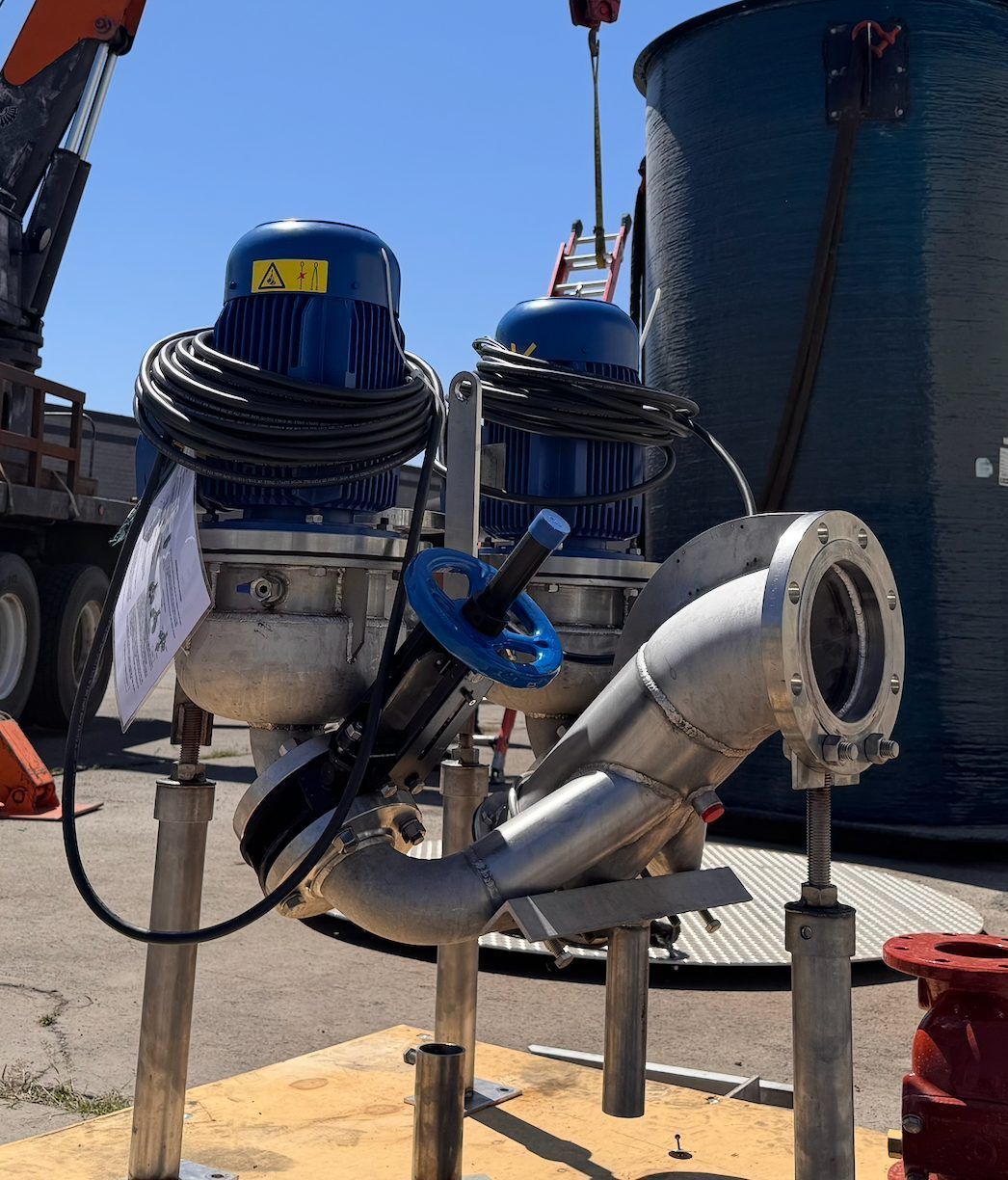
Rhino's OverWatch direct in-line wastewater system is supplied in pairs at minimum, which makes redundancy part of the configuration rather than an option to be value engineered out. OverWatch also removes the wet well from the design entirely. Flow stays in the pipe, which takes away the confined space entry, the accumulated grease and grit layer, the odor complaints, and the submergence calculations that come with a traditional wet well station.
Impeller selection matched to the stream
Solids handling is the decision that determines whether a station runs or rags. OverWatch is available in three impeller configurations so the selection can follow the actual influent rather than a generic assumption.
| Impeller | Efficiency | Best fit |
|---|---|---|
| DIPCUT | About 70 percent | High rag content. Chops and passes stringy material that binds conventional impellers. |
| Vortex | About 50 percent | Heavy or unpredictable solids. Passes solids up to the pipe diameter without contact. |
| High-Efficiency | About 85 percent | Cleaner streams and duty points up to 1,500 GPM where power cost is the priority. |
The tradeoff is deliberate. A vortex impeller gives up efficiency to gain passage, and on a station that clogs twice a month that is the correct trade. On a station with a consistent, screened stream, the high-efficiency selection returns the power cost difference over the life of the equipment.
Packaged systems that arrive tested
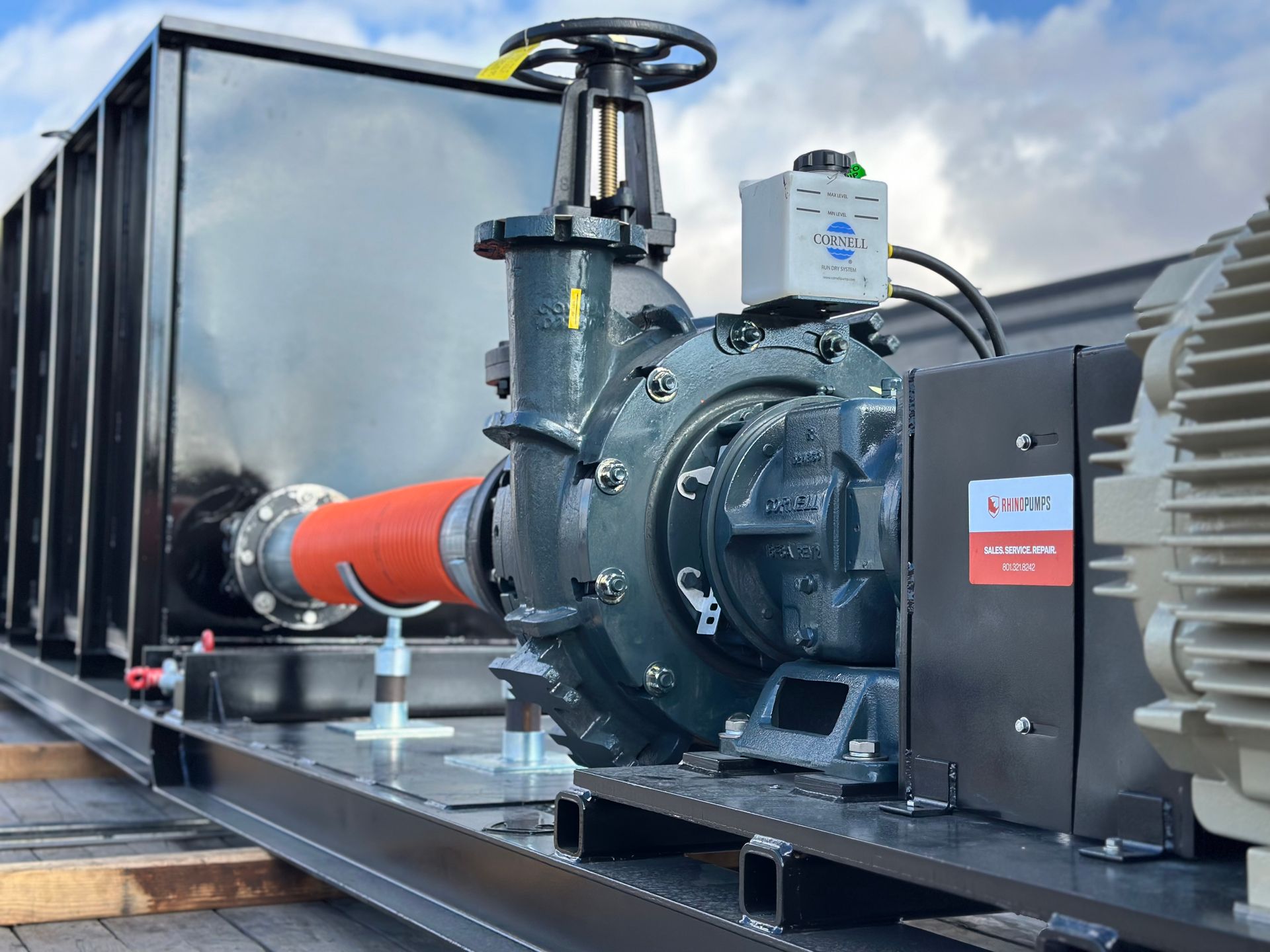
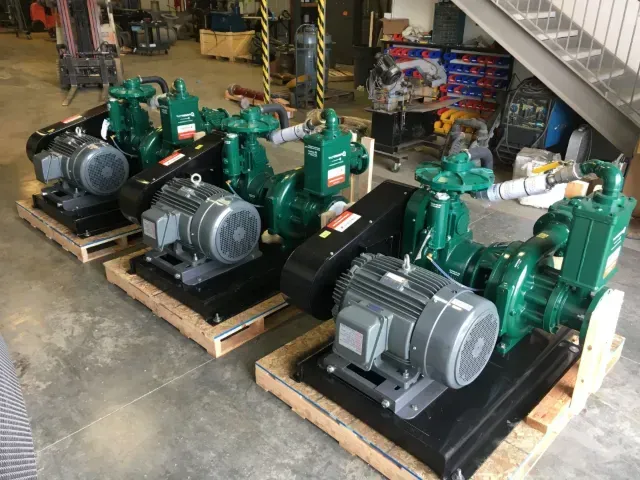
RhinoStak packages the pumps, motors, drives, instrumentation, piping, and enclosure onto a single skid that is assembled and performance tested in our shop before it ships. Controls are available as part of the package and are optional rather than standard, so a plant standardizing on its own control platform is not forced to take ours. The reliability benefit is that the system is proven as a system before it reaches the site, instead of being integrated for the first time during startup with a contractor on the clock. More detail on the packaged approach is on the municipal and industrial pump packages page.
Controls and monitoring that give warning
Kontrols covers the SCADA integration, VFD, and control panel side. Our panel shop is UL 508A listed, so panels are built and labeled to that standard rather than assembled to an unlisted spec. Soft starting through a VFD reduces the mechanical and hydraulic shock that shortens seal and bearing life, and trending motor current against flow and speed is what turns a surprise failure into a scheduled repair. Integration with an existing plant SCADA system is normal work for us; a station does not need to be replaced to be instrumented.
Designing for Resilience Inside an Existing Plant
Most reliability work is not greenfield. It happens inside a plant that has a footprint, a hydraulic profile, an electrical service, and a budget cycle, and the answer has to fit all four.
Practical constraints that shape the solution:
- Footprint. Removing the wet well requirement frees the design from the excavation and structure a new traditional station would need, which matters most on constrained or built-out sites.
- Hydraulics. Total dynamic head on a retrofit is rarely what the original drawings say. Force main condition, added elevation, and new connections all move the operating point, and the selection has to be made against the real curve.
- Electrical. Available service, starting method, and whether standby power and automatic transfer exist will constrain motor sizing before pump hydraulics do.
- Staging. A plant that cannot go off line needs a sequence that keeps flow moving through the changeover, which is a construction planning question as much as an equipment question.
Rhino handles the design, fabrication, and testing in house, and we can look at an existing station and give a straight answer about whether a retrofit is worth doing. On-site assessments are arranged case by case depending on the project and the location. Project turnaround depends on scope, so we quote it per project rather than against a standard lead time.
One scope note, because it comes up: Rhino works on wastewater and industrial process pumping, and we sell and rebuild vertical turbine pumps for applications including mine dewatering. We do not do clean-water municipal well work, well drilling, shaft construction, or shaft service. If that is what a project needs, we will say so rather than take the work.
Service Territory
Rhino Pumps supports municipal and industrial pumping across the Mountain West and Pacific Northwest from branch locations, with engineering and fabrication out of Pleasant Grove, Utah.
Headquarters, engineering, fabrication, and the repair shop.
Municipal and agricultural pumping, packaged systems, and controls.
Municipal wastewater plus mining and industrial pumping support.
Wastewater lift stations, pretreatment, and process pumping.
Municipal treatment and collection system pumping and retrofits.
Front Range municipal and industrial pumping from the Longmont branch.
Pump repair and rebuild work is also accepted from Oregon, New Mexico, Wyoming, and Montana.
Frequently Asked Questions
How do wastewater pump systems impact municipal treatment plant reliability?
Wastewater pump systems determine whether flow reaches the treatment process at a rate the plant can handle, so they set the ceiling on plant reliability. Three factors carry the most weight: redundancy that is verified under real load rather than assumed from a nameplate, impeller and pump selection matched to the actual solids and rag content in the stream, and instrumentation that reports a developing problem before it becomes an outage. When a pump station fails during a wet weather event, the plant loses the opportunity to treat the flow at all, which is why most unplanned bypass events and permit exceedances trace back to pumping rather than to the process train.
How do comprehensive water pump solutions affect municipal treatment plant reliability?
A comprehensive solution improves reliability by removing the integration gaps that a component-by-component purchase leaves behind. When pumps, motors, drives, controls, and instrumentation are engineered, assembled, and performance tested together as one package, the system is proven before it reaches the site rather than integrated for the first time during startup. That also puts accountability in one place, so a performance question does not turn into a dispute between a pump supplier, a panel builder, and an installing contractor. The reliability gain comes from the system being validated as a system and from the operating data it produces once it is running.
What causes most unplanned outages at a wastewater pump station?
Four modes account for the large majority: ragging and clogging that binds the impeller and collapses flow, loss of both duty and standby units to a shared failure point, cavitation from low available suction head during drawdown, and power interruption at a station with no standby power or automatic transfer. Three of the four are selection and configuration issues rather than maintenance issues, which is why a reliability program built only around maintenance tends to stop improving after the easy gains.
Does eliminating the wet well improve reliability?
It removes several failure and cost sources at once. Keeping flow in the pipe takes away the grease and grit accumulation layer, the confined space entry for maintenance, the odor and corrosion exposure, and the minimum submergence calculation that drives cavitation problems on drawdown. The OverWatch direct in-line system is built for this and is supplied in pairs at minimum, so redundancy is part of the configuration rather than an option. It is not the right answer for every site, and the decision comes down to hydraulics, footprint, and the existing electrical service.
Can a new pump system integrate with our existing SCADA?
Yes. Integrating with a plant's existing SCADA platform is routine work for our Kontrols group, and a station does not need to be replaced in order to be instrumented. Our panel shop is UL 508A listed, so control panels are built and labeled to that standard. Controls on a RhinoStak package are optional rather than standard, which means a utility that has standardized on its own control platform can keep it.