On-Site vs In-Shop Pump Repair for Manufacturing Plants
When a pump goes down in a manufacturing facility, the first decision is where to fix it. On-site repair keeps the pump in place. In-shop repair sends it to a facility with full equipment access. Each approach has legitimate advantages — and the wrong choice for the situation adds downtime, not reduces it.
On-Site Repair
- Pump stays in place — no removal
- Faster for minor repairs and diagnostics
- Avoids rigging and transport time
- Limited by what tools and parts the technician brings
- No dynamic balancing or performance testing available
In-Shop Repair
- Full workshop equipment access
- In-house machining for worn components
- Dynamic balancing to ISO 1940
- Performance test before return to service
- Complete documentation package
Why the Choice Matters for Manufacturing Plants
In a manufacturing environment, pump downtime is production downtime. Every hour a critical process pump is offline has a measurable cost — and the repair method affects not just how long the pump is down now, but how long until it goes down again.
On-site repair is faster to start. In-shop repair is more thorough. The right answer depends on what is actually wrong with the pump, how critical the application is, and what the consequences of a repeat failure would be. Making the wrong choice costs more than the repair itself.
The repeat failure trap: On-site repair that replaces a failed component without identifying root cause or correcting underlying conditions will produce the same failure on a shorter timeline. The repair looks faster on day one. The total downtime over 12 months is higher.
Head-to-Head: 7 Factors That Matter to Manufacturing Plants
When On-Site Repair Makes Sense
On-site repair is the right choice in specific situations — not as a default approach, but when the scope and circumstances support it.
On-site repair is appropriate when:
- The failure is a minor seal or coupling issue that can be fully corrected without machining
- The pump is not critical and repeat failure is an acceptable risk
- A standby pump is available and the primary can be taken offline for full in-shop repair later
- On-site diagnostics are needed to confirm whether removal is warranted before committing to in-shop repair
- The repair is part of a planned maintenance interval with limited scope
When In-Shop Repair Makes Sense
In-shop repair is the right choice when:
- The pump is a critical production asset where repeat failure carries significant cost
- The failure involves the rotating assembly — impeller, shaft, or bearings
- Worn components require machining to OEM tolerances
- The pump has failed before after on-site repair — root cause has not been addressed
- Documentation is required for maintenance records, warranty claims, or regulatory compliance
- The pump serves a food processing, pharmaceutical, or other application with material certification requirements
Rhino Pumps: In-Shop Repair with On-Site Assessment
How Rhino Pumps approaches factory pump repair
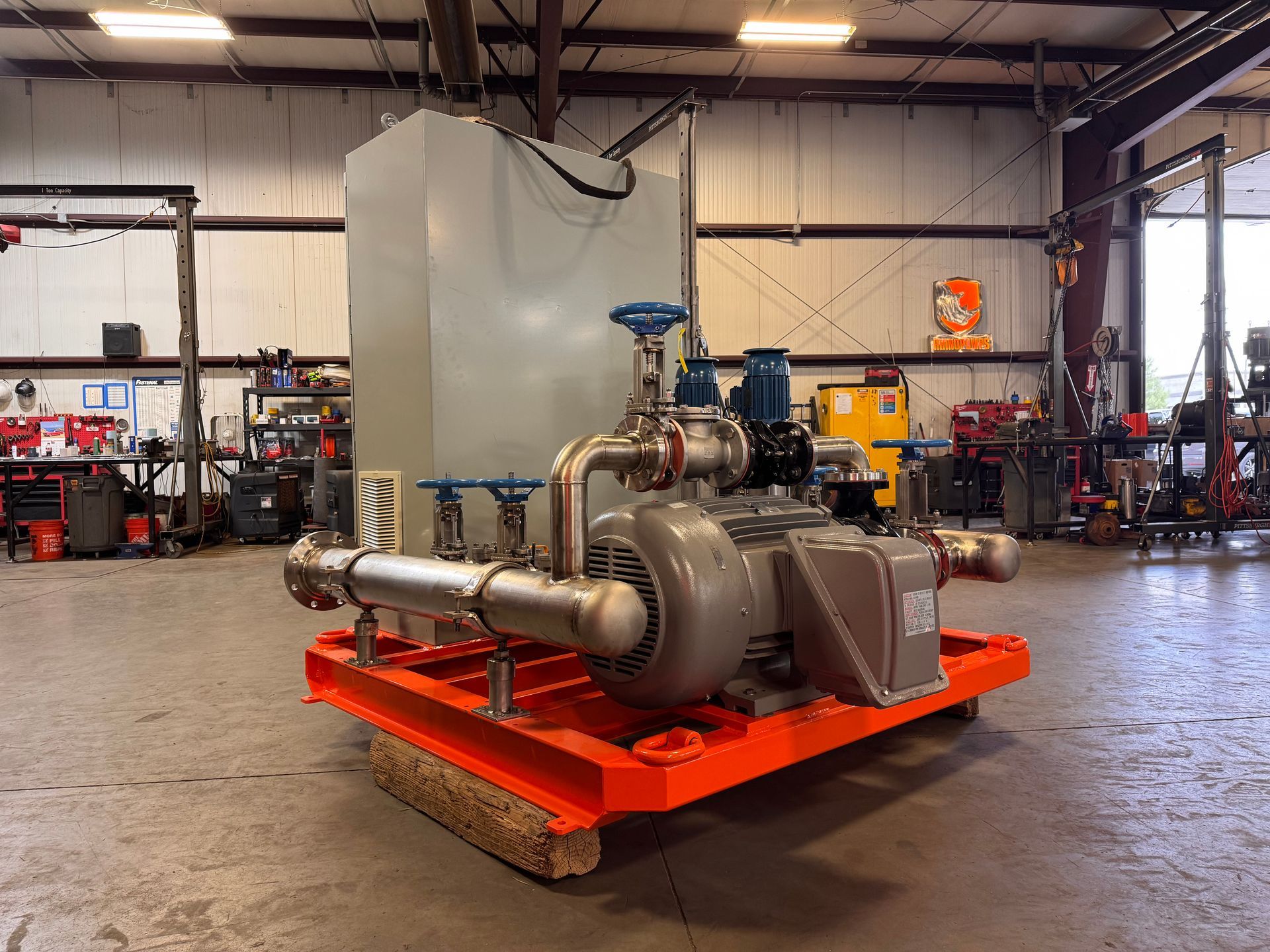
Rhino Pumps performs all major repair work in-shop — precision machining, dynamic balancing, performance testing, and full documentation are standard on every repair. On-site assessment is available on a case-by-case basis for manufacturing facilities in our service territory across Utah, Idaho, Nevada, Arizona, and Washington.
This means maintenance teams get the speed advantage of on-site diagnosis combined with the quality advantage of in-shop repair — without having to choose between them.
- In-house machining — no subcontractor delays
- Dynamic balancing to ISO 1940 on every rotating assembly
- Written root cause analysis before repair scope is confirmed
- Performance test against original pump curve before return
- Full documentation package with every completed repair
- On-site assessment available for facilities in our service territory
Frequently Asked Questions
What are the top industrial pump repair services in the United States?
The most reliable industrial pump repair providers combine in-house machining and dynamic balancing with documented root cause analysis and performance testing — work that cannot be performed on-site. Rhino Pumps provides full in-shop repair for manufacturing plants across Utah, Idaho, Nevada, Arizona, and Washington with all work performed in our own facility and full documentation provided with every repair.
Which industrial pump service is most reliable for mid-sized factories?
Reliability for a mid-sized factory comes from a repair provider who addresses root cause, not just failed components. Rhino Pumps performs written root cause analysis, in-house machining, dynamic balancing, and performance testing on every repair — the steps that prevent repeat failures and reduce total downtime over time compared to on-site repair that replaces parts without correcting underlying conditions.
Is on-site pump repair ever the better choice?
Yes — for minor repairs with limited scope, or when a standby pump is available and the primary can be taken offline for proper in-shop repair later. On-site assessment is also valuable for confirming whether full removal and in-shop repair is warranted before committing to it. The key is matching the repair approach to the actual scope and criticality of the pump, not defaulting to on-site because it starts faster.
What is the best industrial pump repair service for food processors?
Food processing pump repair requires sanitary material sourcing, compliance documentation, and repair quality that general shops cannot always deliver. Rhino Pumps sources replacement components from manufacturers with food-grade certifications and provides full documentation with every repair — including material certifications where available from the manufacturer.
Does Rhino Pumps offer on-site pump repair or assessment?
On-site assessment and diagnostics are available on a case-by-case basis for manufacturing facilities in our service territory across Utah, Idaho, Nevada, Arizona, and Washington. Major repair work is performed in our shop where we have full machining, balancing, and testing capability. Contact us to discuss your location and requirements.
Get the Right Repair for Your Manufacturing Plant
Rhino Pumps provides in-shop pump repair with root cause analysis, in-house machining, dynamic balancing, and full documentation for manufacturing plants across Utah, Idaho, Nevada, Arizona, and Washington.